
StatStrip: A Software Issue May Assign a Glucose Result to the Wrong Patient
Four FDA alerts requiring hospital review: StatStrip glucose meters, Medline kits containing BD ChloraPrep, Philips Lumify ultrasound systems, and Brevital Sodium.
Editorial
This week, four notices from the U.S. Food and Drug Administration (FDA) require attention from biomedical engineering, clinical care, pharmacy, and patient safety teams.
The highest-priority alert involves a hospital glucose meter that may record one person’s result in another patient’s medical record. The remaining notices affect kits used in invasive procedures, portable ultrasound systems, and two lots of an intravenous anesthetic.
Although some of these recalls were issued for the U.S. market, healthcare organizations in Mexico and other countries should review their inventories and confirm with their distributors whether they received any affected products, models, or lots.
A StatStrip meter may assign a result to the wrong patient
Nova Biomedical initiated a global correction for certain StatStrip glucose meters on July 24, 2026. The company issued its announcement on October 5, and the FDA published it on October 6.
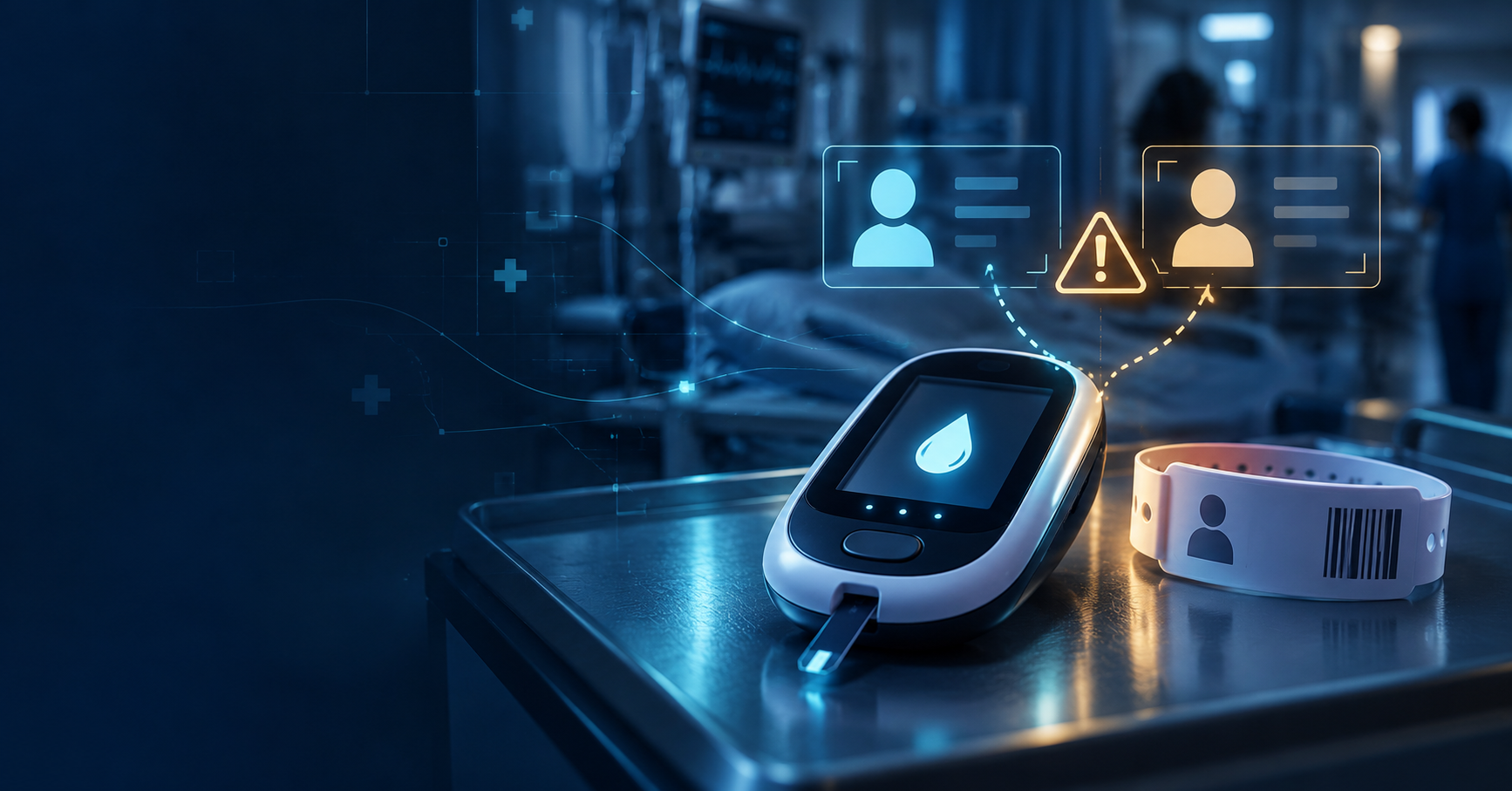
The problem affects the latest model, known as StatStrip Gen 2.0. After scanning a patient’s barcode, the device may continue displaying information from the previous patient. If the operator accepts that information, the glucose result may be recorded in the wrong medical record.
This type of mismatch may result in delayed treatment, failure to provide necessary care, or unnecessary insulin administration. Nova Biomedical reported receiving one adverse event report involving insulin administered based on another patient’s glucose result. StatStrip models Gen 1.0, 1.75, 1.86, and 1.87 are not included in this correction.
Recommended action
- Identify every StatStrip meter used by the organization and confirm its generation and part number.
- After scanning the barcode, verify the patient’s name, date of birth, and other identifiers displayed on the screen before accepting the patient.
- Verify the displayed identity again when the glucose result appears.
- Do not assume that the patient displayed with the result is the same person verified at the beginning of the procedure.
- If a result is assigned to the wrong patient, immediately notify the appropriate clinical lead and system administrator.
- Contact Nova Biomedical or its authorized distributor regarding the software update planned for November 2026.
- If an alternative device is available, consider temporarily discontinuing use of the affected meter in coordination with the manufacturer and the organization’s medical leadership.
Source: FDA — Nova Biomedical StatStrip Global Medical Device Correction
Class I recall of Medline kits containing BD ChloraPrep applicators
The FDA classified the recall of certain Medline convenience kits containing BD ChloraPrep applicators as a Class I recall. This classification is used when continued use of a product may cause serious injury or death.
Under certain environmental conditions, the affected applicators may allow the growth of the fungus Aspergillus penicillioides. If a contaminated product is used to prepare a patient’s skin before catheter placement or surgery, it may result in systemic infection, sepsis, or other serious complications.
Identified products include:
- ChloraPrep Clear 1 mL applicator, item 930480, lot 4032183.
- FREPP Clear 1.5 mL applicator with paper lidding, item 930299, lot 4073005.
- Medline convenience kits included in the FDA’s complete affected-product list.
Recommended action
- Review inventory in storage areas, operating rooms, catheterization laboratories, intensive care units, and procedure carts.
- Quarantine affected kits and discontinue their use.
- Consult the complete affected-product list rather than identifying products only by the kit’s brand name.
- For products included in the updated communication, follow the instruction to destroy the entire kit after completing the corresponding response forms.
- Confirm the procedure applicable in your country with Medline, BD, or the distributor that supplied the product.
Source: FDA — Medline Convenience Kits affected by the BD ChloraPrep recall
Philips Lumify may temporarily lose scanning functionality
The FDA issued an early alert concerning the Philips Lumify portable ultrasound system for Android and iOS.
One of the identified software issues may cause the application to stop recognizing a previously registered transducer. The system then requires the user to register the transducer again before scanning can continue. This process requires access to Wi-Fi or a cellular connection.
Philips is also investigating USB cable disconnections or instability between the transducer and the phone or tablet. Either condition may interrupt device functionality and delay diagnosis or treatment.
The risk is particularly relevant in ambulances, aircraft, remote locations, and areas with limited connectivity. As of September 29, 2026, Philips had reported eight serious injuries and four deaths associated with this issue to the FDA.
Recommended action
- Identify all Philips Lumify systems in operation and verify the installed application version.
- Use the system in areas with accessible Wi-Fi or cellular service unless another ultrasound system is immediately available.
- Keep a backup ultrasound device or alternative diagnostic method ready for use.
- Inform everyone who uses Lumify about the problem.
- Post the Philips notice near affected systems.
- Continue monitoring manufacturer and FDA updates while Philips develops the software correction.
Source: FDA — Early Alert for the Philips Lumify Diagnostic Ultrasound System
Two lots of Brevital Sodium recalled due to cellulose particles
Par Health voluntarily recalled two lots of Brevital Sodium 500 mg per vial, also identified as methohexital sodium for injection. The recall was announced on October 8, 2026, and published by the FDA on October 9.
The product contains particulate matter identified as cellulose. Administering an intravenous product containing particles may cause pulmonary embolism, obstruction of other blood vessels, tissue or organ damage, and inflammation of the veins.
The affected lots are:
- 86930, expiring in February 2028.
- 88623, expiring in April 2028.
Par Health stated that it had not received any reports of adverse events related to the recall as of the announcement date.
Recommended action
- Ask the hospital pharmacy to immediately review its inventory of Brevital Sodium 500 mg.
- Discontinue use and distribution of lots 86930 and 88623.
- Physically separate affected products to prevent accidental administration.
- Coordinate the return process with the supplier or distributor.
- Inform anesthesiology and the appropriate clinical departments to ensure that alternatives are available.
Source: FDA — Par Health recall of Brevital Sodium
What your organization should review today
- Biomedical engineering: Models and software versions of StatStrip meters and Philips Lumify systems.
- Nursing and patient safety: Identity verification procedures before and after glucose testing.
- Operating rooms and infection prevention: Medline kits containing BD ChloraPrep applicators.
- Pharmacy and anesthesiology: Brevital Sodium lots 86930 and 88623.
- Procurement and inventory management: Product traceability through national distributors and importers.
Clinical technology does not need to suffer a cyberattack to create risk. Data assigned to the wrong patient, a contaminated product, or a device that loses functionality during care may be enough to affect a clinical decision.
An effective response begins with an accurate inventory, clearly assigned responsibilities, and a procedure that turns every manufacturer alert into a verifiable action.
If this edition of Bisturí Digital was useful, share it with the people responsible for biomedical engineering, pharmacy, patient safety, and clinical technology at your organization.
The analysis and prioritization presented in Bisturí Digital are the editorial responsibility of Roberto Manzo. This publication is provided for informational purposes and does not replace manufacturer instructions or the clinical, technical, or regulatory guidance applicable to each organization.