
When a Cyberattack Reaches the ER: Two Mexican Hospitals on the Radar and a German Hospital Disrupted
Two Mexican hospitals appear on a ransomware tracker, while an attack temporarily closed an ER in Germany. Cybersecurity is now a clinical safety issue.
Editorial
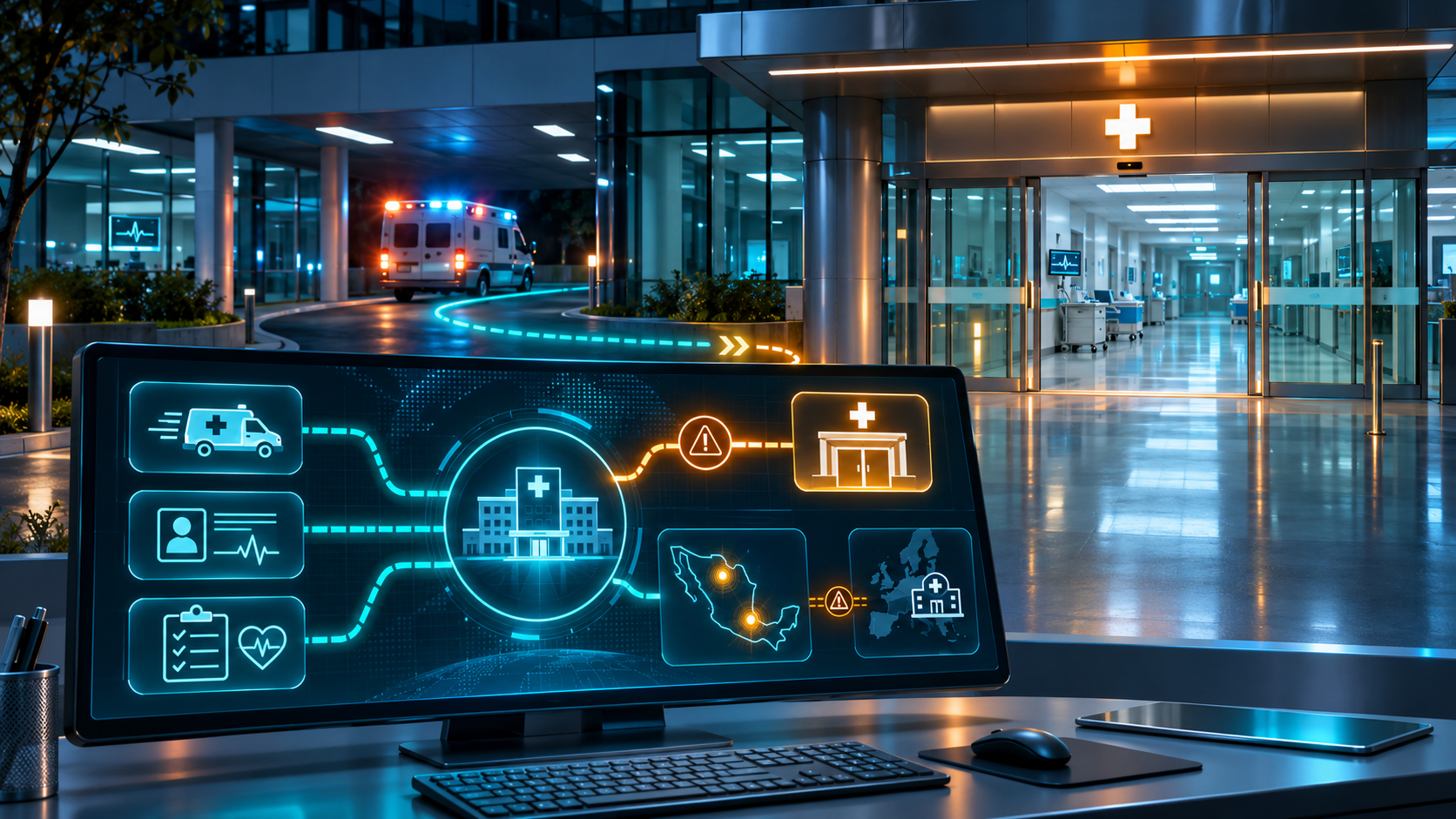
This week, Bisturí Digital cannot discuss cybersecurity as if it were separate from patient care. The attack against Kreiskrankenhaus Greiz‑Ronneburg in Germany forced the hospital to temporarily stop receiving patients in its emergency department. Medical equipment continued to operate, but data connections and digital treatment plans were affected. Emergency services had to coordinate the transfer of patients to other hospitals.
At the same time, our website’s Radar section “which is fed by ransomware.live data” identified two Mexican hospitals included in posts attributed to ransomware groups. We must be precise: appearing on a data-leak site is a claim made by the attackers, not independent confirmation from the affected institution. Yet it is not a signal that should be ignored. It is an early indicator that calls for validation, monitoring and preparation.
We are concerned by the frequency with which attacks are reaching the healthcare sector and by how quickly a digital intrusion can become a disruption to care. In a hospital, losing access to medical records, diagnostic studies, laboratory results, treatment plans or internal communications is not merely an IT problem. It can delay clinical decisions, increase the burden on staff and narrow the patient’s margin of safety.
Artificial intelligence is also changing this environment. It can help attackers automate reconnaissance, create more convincing campaigns and accelerate the exploitation of vulnerabilities. But it can also strengthen defense through earlier detection, behavioral analysis and risk prioritization. The answer is not to adopt AI without controls, but to examine whether our cybersecurity strategy is ready for faster and more persistent attacks that can directly affect care delivery.
In healthcare, cybersecurity should be measured through clinical questions: can we continue treating patients, can we access the information we need, can we administer medication safely, and can we receive an ambulance? If the answer depends on a digital system, that system is part of patient safety.
Two Mexican hospitals appear on the radar: a signal that requires verification
Our Radar section, based on information collected by ransomware.live, shows two Mexican hospital organizations posted as alleged victims by ransomware groups. Platforms of this kind monitor data-leak sites used by criminal actors to announce victims, apply pressure during negotiations or publish allegedly stolen information.
The number must be interpreted carefully. A criminal post does not, by itself, demonstrate that clinical systems were encrypted, care was interrupted or the displayed data is authentic. Days or weeks may also pass between initial access and publication. For this reason, Bisturí Digital will use the term “claimed victim” unless the institution, an authority or a reliable independent source confirms the incident.
The important step for a hospital is not to speculate about a victim’s identity, but to turn the signal into a preventive review.
What to do:
- Review remote access, privileged accounts and vendor credentials used during the past 30 days.
- Verify that clinical backups are isolated, recoverable and have been tested recently.
- Confirm that manual procedures exist for emergency care, admission, laboratory, pharmacy, imaging and medication administration.
- Define who has the authority to isolate systems without waiting for an approval chain that is incompatible with an emergency.
- Prepare communications for patients and staff that do not disclose sensitive information or attribute the incident before evidence is available.
Greiz‑Ronneburg: when a digital attack changes an ambulance’s destination
The Greiz district confirmed that Kreiskrankenhaus Greiz‑Ronneburg suffered a cyberattack detected on the morning of November 15. The hospital began its analysis, notified the state criminal police and public prosecutor, and temporarily stopped receiving new patients in the Greiz emergency department. In an emergency, residents were instructed to call 112 so that the Gera control center could determine the appropriate destination hospital.
On November 16, the hospital reported that medical equipment remained operational and patient safety was being maintained, but data connections were experiencing problems. Emergency admissions began to resume gradually in coordination with rescue services and nearby hospitals. Authorities confirmed an extortion attempt, although they have not disclosed the initial-access vector, the technical scope or whether data was extracted.
The case matters because it demonstrates real impact without requiring speculation: even when clinical devices remain powered on, the loss of connectivity and digital treatment plans can limit a hospital’s ability to receive patients and coordinate care.
What to do:
- Include ambulance diversion and partial ER closure in ransomware continuity and response exercises.
- Maintain printed or offline contact lists for alternative hospitals, laboratories, blood banks and authorities.
- Test procedures for clinical documentation, prescribing and medication administration during an extended electronic health record outage.
- Ensure that clinical teams know how to report digital anomalies without shutting down medical devices or destroying evidence.
- Coordinate exercises across IT, clinical engineering, medical leadership, emergency care, communications and data protection.
Read the official Greiz district statement
Intersurgical breathing tubes: risk of disconnection during use
The FDA issued an early alert for Intersurgical 22 mm Smoothbore breathing tubes and systems. The manufacturer found that some soft connectors may separate from the tube because an insufficient amount of solvent was used during manufacturing. A disconnection can interrupt or compromise ventilation, cause oxygen desaturation and, if ventilation is not quickly restored, lead to organ damage, brain injury or death from hypoxia.
The FDA states that, as of November 3, no serious injuries or deaths associated with the issue had been reported. The notice includes specific references and lot numbers; products that are not included should not be removed indiscriminately.
What to do: identify the references and lots published by the FDA, stop using them, quarantine them and coordinate their return with Intersurgical. If a circuit is connected to a patient, any replacement must be prepared and performed under clinical and clinical-engineering supervision.
Read the FDA alert for Intersurgical
Arrow International guidewires: potential coating detachment
Arrow International, a Teleflex subsidiary, removed products containing hydrophilic-coated spring wire guides. The coating may swell inconsistently when exposed to saline, form clumps and release particles into the bloodstream. Potential consequences include inflammation, thrombosis, ischemia, tissue injury, stroke, additional interventions or death.
As of November 5, the manufacturer had reported no associated serious injuries or deaths. The alert covers guidewires as well as various kits and catheters that contain them, so the review must use the reference and lot number rather than only the trade name visible on the main package.
What to do: stop using and distributing affected products, quarantine them and arrange their return through Teleflex or Arrow International. Procurement, inventory, interventional services, infusion therapy and all areas that place vascular access devices should participate in the search.
Read the FDA alert for Arrow International
In brief
- Cardinal Health and BD Alaris: some Presource kits contain BD Alaris infusion sets covered by an earlier correction. Verify inventory, reference and lot information with Cardinal Health before using the kit.
- Medline beds: the repair and replacement program covers beds, rails, mattresses and accessories associated with fire or entrapment hazards. Confirm models with the manufacturer and avoid improvised local modifications.
- Check Point: a campaign against unpatched gateways used PHP2Shell for initial access and CVE‑2026‑123039 for privilege escalation. In hospitals using Mobile Access, patching is not enough: teams must also search for web shells, persistence and lateral connections.
- ConnectWise ScreenConnect: if the hospital uses the platform for remote support, confirm its version, installed extensions and administrative-account activity. A compromised support platform can provide a path to many systems.
- Citrix NetScaler and Mitel MiCollab: these systems often support remote access and clinical communications. They belong in the critical inventory and in priority maintenance windows, especially when they are exposed to the internet.
Closing thoughts
The Greiz‑Ronneburg case summarizes this week’s concern: a ventilator or infusion pump does not need to be attacked directly for care to be affected. Losing data connections, medical records, digital treatment plans or the ability to accept new emergency patients can be enough.
The two Mexican entries observed in our Radar should not be used to name or blame institutions without confirmation. They should remind us that Mexico’s healthcare sector is part of the same threat environment and that public silence does not mean incidents are absent.
Every hospital should be able to answer three questions today: how long can it operate without its digital systems, which clinical services degrade first, and who decides when to activate contingency mode? If those answers are not documented and tested, the next ransomware exercise should not wait until the next quarter.
Until next week.
Roberto Manzo
Information from ransomware.live is based on posts attributed to criminal groups and does not, by itself, constitute independent confirmation of an incident. The analysis and prioritization expressed in Bisturí Digital are the editorial responsibility of Roberto Manzo and do not replace manufacturer instructions, health-authority guidance or a technical assessment specific to each institution.